
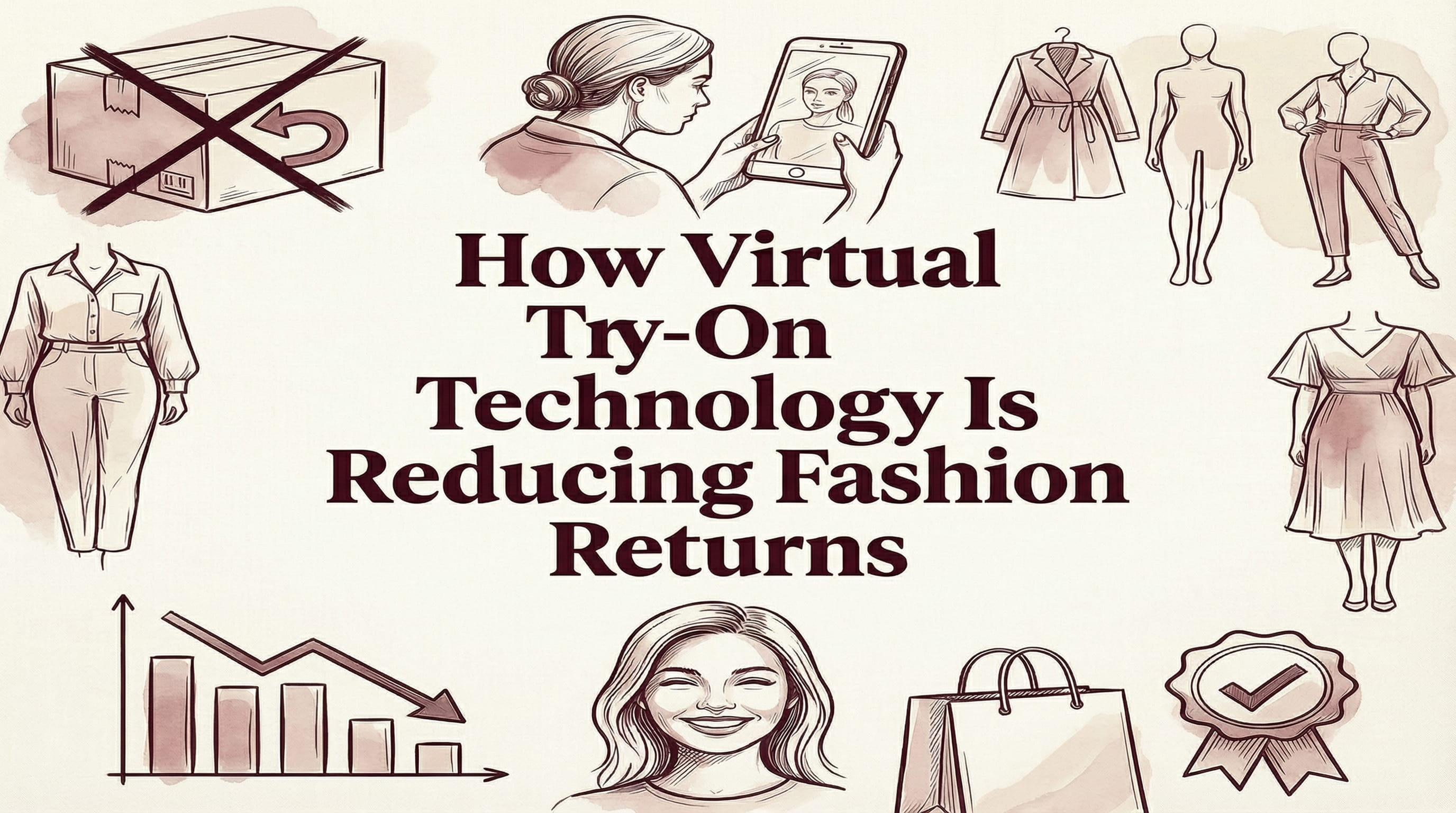
Fashion e-commerce has a returns problem. Across the industry, clothing returns average 25-40% — compared to just 8-10% for non-fashion online purchases. Each return costs retailers an estimated $10-30 in processing, shipping, and restocking, and many returned items never make it back to saleable inventory. For a brand doing $500K/year in revenue with a 30% return rate, that's $50,000-150,000 lost annually to returns alone.
The root cause? Uncertainty. Customers can't touch the fabric, try on the fit, or visualize how a garment will actually look on their body. They buy hopefully, receive the product, and return it when reality doesn't match expectation.
AI-powered product visualization directly attacks this uncertainty by providing better visual information before the purchase decision. When brands replace flat-lay photos with realistic on-model imagery — showing products on diverse body types from multiple angles — customers make more informed purchase decisions. The data is compelling: brands implementing high-quality on-model imagery report 15-25% reductions in return rates.
Why Fashion Returns Happen
Understanding the reasons behind returns reveals exactly where virtual try-on technology can help:
| Return Reason | % of Returns | Can Virtual Try-On Help? |
|---|---|---|
| Doesn't fit as expected | ~50% | ✅ Shows garment on body proportions |
| Doesn't look as expected | ~25% | ✅ Realistic visualization reduces surprises |
| Wrong size ordered | ~10% | ⚠️ Partially — shows proportions, not sizing |
| Quality issues / defects | ~10% | ❌ Manufacturing issue, not visual |
| Changed mind / bought alternatives | ~5% | ⚠️ Higher pre-purchase confidence helps |
The top two reasons — "doesn't fit as expected" and "doesn't look as expected" — account for ~75% of fashion returns. Both are directly addressable with better visual content. When customers can see a product on a model with proportions they can relate to, the gap between expectation and reality narrows dramatically.
How Virtual Try-On Imagery Reduces Returns
1. Better Fit Visualization
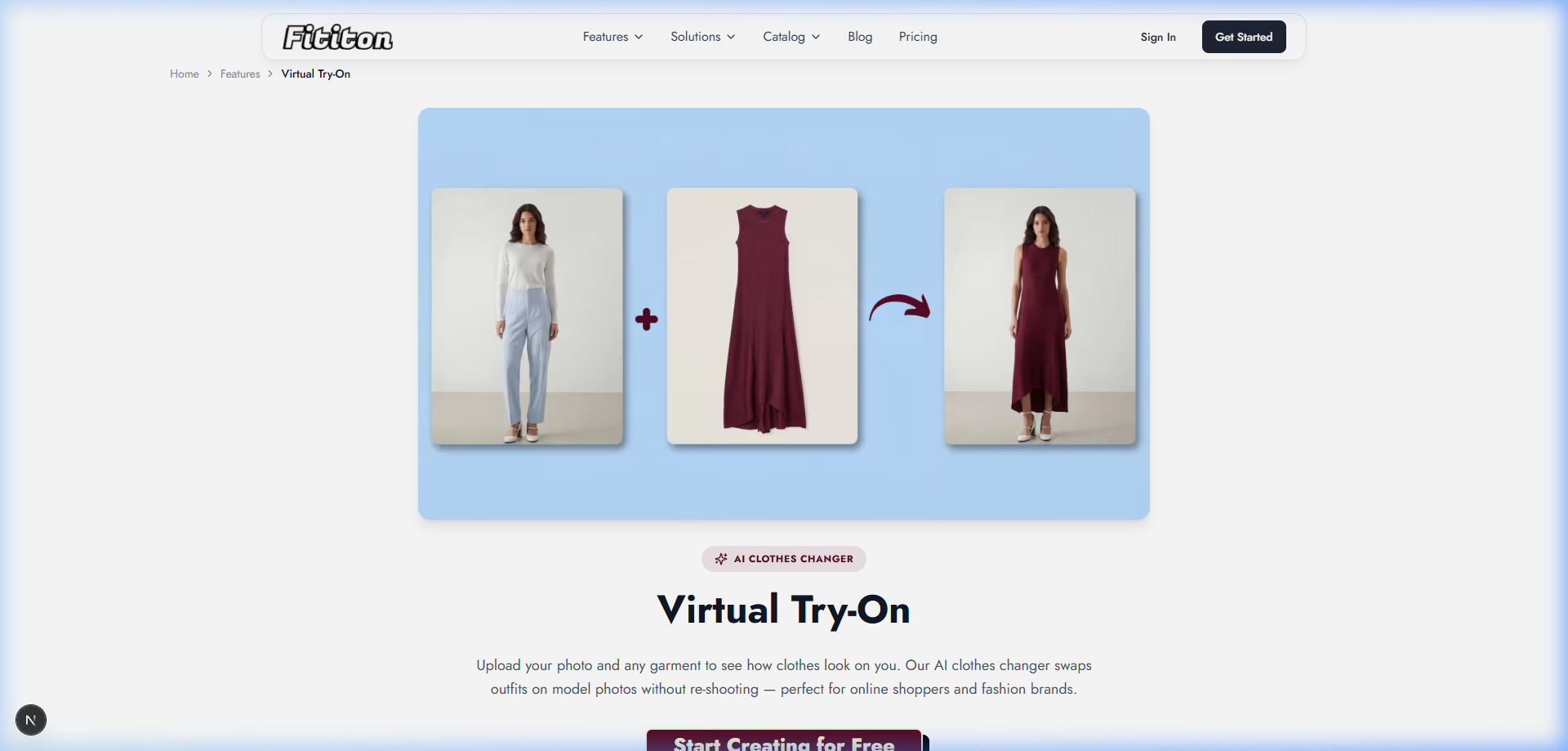
When a product is shown on a flat surface or ghost mannequin, the customer has to imagine how it will look on a body. When it's shown on a realistic model with relatable proportions — through AI-generated on-model imagery — that imagination gap closes. The customer can see how the garment actually drapes, where it falls, and how the silhouette looks.
2. Diverse Model Representation
One of the biggest return drivers is the disconnect between the model in the product photo and the customer's own body type. When a slim model wears every garment, customers with different body types have no visual reference for how the item will look on them.
AI photography makes it economically viable to show every product on multiple body types, skin tones, and demographics. With tools like Fit It On, generating an additional model variation costs just 1 extra credit (~$0.10) — compared to booking another model for a traditional shoot. Brands that show products on 3-4 diverse models see measurably lower return rates across all customer segments.
3. Multiple Angles and Poses
A single front-facing product photo leaves too much to the imagination. How does it look from the side? How does it drape in the back? Using pose control and multiple angle generation, brands can show 3-5 different views of the same product on the same model — front, side, back, walking, and sitting. More visual information = more confident purchases = fewer returns.
4. Video for Dynamic Visualization
Static images can't show how a garment moves. AI-generated video clips show the model shifting weight, fabric swaying, and natural movement — giving customers a much better sense of how the garment behaves in real life. Product pages with video see up to 80% higher conversion and correspondingly lower return rates.
The ROI Math
Let's run the numbers for a brand doing $30,000/month in revenue with a 30% return rate:
| Metric | Before | After (20% reduction) |
|---|---|---|
| Monthly revenue | $30,000 | $30,000 |
| Return rate | 30% | 24% |
| Returns (units @ $50 avg) | 180 units | 144 units |
| Revenue lost to returns | $9,000 | $7,200 |
| Processing cost ($15/return) | $2,700 | $2,160 |
| Monthly savings | — | $2,340/month |
A 20% return reduction saves $2,340 per month — $28,080 per year. The cost to achieve this? A Fit It On Pro plan at $29/month. While the exact impact varies by product type and current imagery quality, the ROI potential is significant — even a 10% return reduction more than pays for the tool.
The Environmental Impact
Fashion returns aren't just a financial problem — they're an environmental one. The environmental cost of returns is staggering:
- 5 billion pounds of returned clothing ends up in landfills annually in the US alone
- Each return generates additional shipping emissions (often 2x the original delivery — return shipment + potential reshipping)
- Returned items frequently can't be resold at full price and are either discounted, donated, or destroyed
- Processing returns requires warehouse labor, inspection, repackaging, and often re-tagging
By reducing unnecessary returns through better product visualization, AI-powered imagery doesn't just save money — it contributes to a more sustainable fashion supply chain.
How to Implement Virtual Try-On Imagery
Here's a practical implementation plan to start reducing returns with AI-generated product imagery:
- Identify your highest-return products: Pull your return data and rank products by return rate. These are your priority targets.
- Generate diverse on-model imagery: For each high-return product, generate on-model photos with 2-3 different AI models covering different body types using Fit It On's product-to-model.
- Add multiple angles: Generate 3-5 angles per product (front, side, back) using pose control.
- Add video: Create a short video clip for each high-return product using image-to-video.
- A/B test: Run the new imagery against old imagery for 2-4 weeks and track return rate changes.
- Roll out: Apply successful imagery approach across your full catalog.
Explore More AI Tools
Fit It On offers a full suite of AI-powered tools beyond what we covered above. Here are a few more worth exploring:
- Model Swap — Replace the model in any existing on-model photo while keeping the garment, lighting, and composition intact.
- Prompt Try-On — Generate on-model images from a text description alone, no garment photo needed. Great for pre-production visualization.
- Generate Angles — Create front, back, and side views from a single product image. No reshooting required.
- Ghost Mannequin Removal — AI-powered invisible mannequin effect without manual Photoshop editing.
FAQ
How much can virtual try-on reduce returns?
Industry benchmarks suggest 15-25% return rate reductions for brands implementing realistic on-model imagery. The exact impact depends on your current return reasons, product types, and how different the new imagery is from your existing content.
Does showing products on multiple body types increase sales?
Yes. Brands that show products on diverse body types report both higher conversion rates across all customer segments and lower return rates, as customers can self-select the model that most closely matches their own body type.
How much does it cost to implement?
With Fit It On, the Pro plan at $29/month provides 300 credits — enough to generate on-model imagery for 100 products with 3 angles each. For larger catalogs, the Agency plan at $69/month provides 1,000 credits. Given that a single prevented return saves $10-30, the tool pays for itself after preventing just 1-3 returns per month.
Can virtual try-on replace a size chart?
No — they're complementary. Virtual try-on shows how a garment looks and drapes on a body, while size charts provide specific measurements. Use both for the most complete customer experience.


